Blog Archives

Get Behind Me Satan!
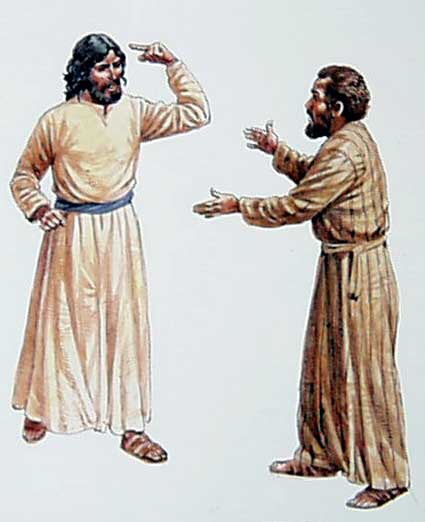
In Matt 16, when Peter rebuked Jesus about the things he was telling them would happen to him, Jesus said something that has always bothered me.
Matthew 16:23
But He turned and said to Peter, “Get behind Me, Satan! You are an offense to Me, for you are not mindful of the things of God, but the things of men.”
Peter only had Jesus’ welfare in mind, why would he call him Satan?
Was Peter possessed?
We get a clue from the second half of the verse. “you are not mindful of the things of God, but the things of men.”
Hmmm? If something is originating out of human thinking instead of the intentions of God, is that satanic?
Let’s take a look at how the Young’s Literal Translation words this verse.
Matthew 16:23
and he having turned, said to Peter, `Get thee behind me, adversary! thou art a stumbling-block to me, for thou dost not mind the things of God, but the things of men.’
The Greek word for satan literally means adversary. It is not necessarily, or for that matter ever, a name or title of an individual.
Think of this, Iran has called America the “Great Satan” and Israel the “Little Satan”. Do they mean that we all have horns and pointy tails and run around with pitchforks? No, the word means the same to them as it has for millennia, an adversary. We are the great satan because we are much bigger and more powerful than Israel and to them, we are their biggest adversary.
For Peter to tempt Jesus with a thought to avoid what he knew was coming and necessary meant that he had become an adversary, someone who was contrary to his agenda. He was not inferring that Peter was possessed but that he was putting on obstacle and an opportunity to fail in front of him. Peter was not considering the plan of God but his own desires. That is what made him an adversary to Jesus.
Any time we put our own agenda ahead of God’s we are falling into the same trap as Peter. We are not possessed but we are hindering what God wants to do. Even if it doesn’t make sense to our natural mind we have to remember that His thoughts are higher than our thoughts and his ways higher than our way.
There doesn’t always have to be a supernatural boogie man behind everything. Sometimes it is just our own limited understanding of what God is doing.
Blessings,
Jeff
What’s Your Word?
John chapter 1 verse 1 says “In the beginning was the Word, and the Word was with God, and the Word was God.”
We know that John is talking about Jesus Christ, he is the Word of God. But what exactly does that mean? We also know that he is not confined to the pages of a book, or an iPad or iPhone or whatever you use as your Bible. So what does it mean when we say that Jesus is the Word of God?
My second question, actually two questions, before we answer the first one, is “If God has a Word and we are created in the image do God, do we have a word?” and “If God’s word is Jesus, what is ours?”.
Ok, so when we talk about the word of God we’re not talking about a book, we’re talking about a person and what that person represents but to understand what is meant when Jesus is called the Word we have to dig into the Greek meaning. The Greek word for “word”, as it’s used in John 1:1 is logos, logos is a very interesting word and used several different ways because of its meaning, which is – something spoken, a reasoning, a computation or accounting, the sum total of ideas.
Logos has the meaning of the full expression of thought, something that has been carefully considered and expressed to convey everything that needs to be said about the subject. So, when we say that Jesus is the Word of God, we’re saying that he is God’s complete expression. Everything that he wanted to convey to us about himself and his nature he expressed through his son, Jesus Christ!
When Phillip desired to see the Father Jesus answered him “Have I been with you so long , and yet you have not known Me , Philip? He who has seen Me has seen the Father.” (John 14:9) Jesus himself knew that he was the exact representation of God the Father and that if there’s something we want to know about God we have to look no farther than Jesus.
Now on to my second question, if we are made in the image of God, do we have a word or logos? The answer is yes, we have a logos but I’m afraid that our’s hasn’t been as carefully considered and expressed as God’s has.
To prove this I’ll take you to a portion of scripture that used to scare the crap out of me until the Lord gave me some insight into what it really means.
Matthew 12:36-37
But I say to you that for every idle word men may speak, they will give account of it in the day of judgment. 37 For by your words you will be justified, and by your words you will be condemned.”
Wow! Talk about putting a load on you, for every word that comes out of our mouth, we are going to have to stand in front of God and explain the things we said! I would be better off if I was mute because I’m sure there are things I’ve said that God is not going to be proud of and I’m sure I won’t be proud of either. This verse is even in red, Jesus said it so it has to be true! (There is a little sarcasm in that last sentence because I believe all the Bible is true, not just the words in red.)
So, if Jesus says we’ll be judged by our words, what does that mean and how does it fit with what we’re discussing? It all comes back to the Greek meaning and the English translation. To start with we have two Greek words for our one English word for “word” and we have two English words that are translated differently from the same Greek word. Confused? Hopefully you wont be in a minute.
Remember that I said that the Greek the word translated as “word” is logos. Well, in this passage we are introduced to the other Greek word for “word” and that is rhema. Rhema has a little different meaning than logos and that makes a lot of difference here. Rhema means something spoken but it is more focused than logos, rhema is a specific subject or topic, it is a word for the moment.
Here is a simple little illustration that may help.
The Bible is the word of God, from cover to cover it contains everything he wanted to say to us. That’s logos!
John 3:16 tells us why he sent Jesus to us. That’s rhema!
In Matt.12:36 Jesus says “for every idle word”, ok, this time it’s rhema, not logos, so he is talking about a word of the moment. On top of that he narrows it down even more by saying every “idle” word. This little addition of an adjective changes your understanding of what he is really saying.
When I hear the phrase “idle word” I think of things we say nonchalantly or casually, just joking around or even as a reaction, like if you mash your finger and a little cuss word slips out. That’s why this verse used to bother me so much because I’m not always as careful with my words as I should be. I found it unfair to be judged eternally for words I put little thought into but that is not what Jesus is talking about here. Do we need to guard our tongue and be more intentional in what we say? Absolutely! But Jesus has something totally different in mind when he says that for every idle word we speak we will give account at judgement day.
It comes back to the word “idle”. To me, when I think of idle I think of just sitting around, doing nothing or a car that’s running but not in gear. So, an idle word is one that is produced out of a mind that is not engaged, it’s said without much thought and therefore carries little meaning or weight, there’s not really any purpose behind it.
That’s really not the meaning behind the Greek word, it has more to do with what idleness produces than the state of being idle itself. Think about what comes from idleness……….. that’s right, nothing! Idleness is unproductive, it causes barrenness. If someone is idle they are going nowhere and the potential that lies within them remains untapped, unrecognized and useless. So an idle word is one that causes barrenness, unfruitfulness and a person’s potential to go unrealized.
If the two words are combined, like we have here, an “idle word” becomes a specific word spoken that’s purpose is the bring about barrenness. The word itself isn’t idle, in fact, just the opposite. When the word is spoken it begins to produce unfruitfulness in the person it was said to.
Here are a few of examples of idle words.
“You’ll never amount to anything.”
“You’re so stupid!”
“Can’t you do anything right?”
Get the picture? These are the things that we say that cause others to feel unwanted, unloved and worthless. Some people would call these “word curses”. This type of comment attaches itself to the person’s perception of themselves and causes them to pull back, to retreat into a safe area where they refuse to attempt anything for fear of failure. Failure becomes the enemy to avoid at all costs so productivity and creativity are abandoned and replaced with something that is comfortable and safe, where success is virtually assured or they won’t even try. When repeated often enough, for some it crushes completely and they never recover.
That’s the kind of idle word Jesus is referring to, those are the type of things that we need to guard against at all cost. When we say things that are intentionally hurtful, degrading or embarrassing to others, those are the type of things we will be judged for. Those are the things for which we will have to give an account. Which brings me back to our word logos.
My second question was “Do we have a logos?” and this is where we find that yes, we do have a logos! We just finished finding out that we will have to give an account for idle words and when you dig a little deeper you find that the word “account” here is actually logos. When we go before God at the judgement we will present our ‘word’ or our logos. Jesus then says “for by your ‘logos’ you will be justified and by your ‘logos’ you will be condemned.”
Since logos is the complete expression it is made up of our rhema, our words for the moment or circumstance. I honestly don’t believe that the Father is going to bring up every unkind thing we have ever said, although that is a part of our logos. I believe that God is looking specifically for what we have said about his son Jesus. If we have confessed Jesus as our Lord and Savior, if we have said that we believe in his death, burial and resurrection, then we are under the blood of Jesus and the rest of our logos is covered by the forgiveness that he paid for. If our logos contains the right confession of Christ we will be justified!
On the other hand, if our logos does not contain a confession of Jesus, then all those hurtful words will count against us because there is no forgiveness outside of the blood of Jesus Christ. If that is the condition of our logos on judgement day then we will be condemned.
I hope I have answered my own questions in a way that makes sense and since we do have a ‘word’, as God does, we need to be more intentional about what makes up that word. Especially when it comes to what we have to say about Jesus but we also need to make sure that it doesn’t contain “idle words”, our complete expression shouldn’t be one that causes others to become unfruitful. On the contrary, we should have “zoe rhema”!
Words of life, that make up the bulk of our logos.
Blessings!
Jeff Martin
Moron Grace! Sorry, More On Grace!
1 Timothy 1:8-11
8 But we know that the law is good if one uses it lawfully, 9 knowing this: that the law is not made for a righteous person, but for the lawless and insubordinate, for the ungodly and for sinners, for the unholy and profane, for murderers of fathers and murderers of mothers, for manslayers, 10 for fornicators, for sodomites, for kidnappers, for liars, for perjurers, and if there is any other thing that is contrary to sound doctrine, 11 according to the glorious gospel of the blessed God which was committed to my trust.
For those of you who insist on being under the law of Moses and (I cringe as I write this) that includes the Ten Commandments because they are part of the law, you must be willing to take your place among this list of offenders. If the law is not made for righteous people then you can’t achieve righteousness by keeping it, therefore you assign yourself to the place of the sinner when you measure yourself by the law and not according to God’s grace.
Paul said that the law is good……IF…….it is used lawfully. To use the law lawfully you apply it to the law breakers, along with the punishment prescribed by the law, and they include all those who rebel against God by refusing to be reconciled to Him through the blood of Jesus Christ. Therefore, those who have believed in faith and been reconciled to God have been excluded from the law. In fact, in Colossians 2:14 Paul says that the handwriting of requirements (which is the law) have been wiped out and removed from us because they were working against our relationship with God, so he took it out of our way and nailed it to the cross! If you have been exempt from a requirement you couldn’t keep, why would you insist on trying anyway? You would have to be a moron!
It blows me away to think of how easily we slip back into the thinking that we have to perform at a certain level to be okay with God, that if we just try really hard and do all the right things God will be happy with us. The worst thing is that most of our christian teaching will help send you back down that road. We are an achievement based society and without the law we think we don’t have a way to gauge our progress.
Here’s how it would go for most of us: Am I keeping the first commandment, no other gods before Him, check! Well, unless you count the fact that I put most of my time and energy into acquiring and maintaining a bunch of stuff instead of into my relationship with God. Okay, maybe half a check. Second commandment, no engraved images, no idols, check! I don’t worship idols, uh, unless you count money because I have to have it to buy all that stuff I don’t really need and I’ll do almost anything to get it, oh and there are images engraved into all our coins. Okay, uncheck. Third commandment, don’t take the Lord’s name in vain, check! I would never do that as long as you don’t count all the OMG’s and other times I invoke the name of God with no honor or the respect that is due to Him. Okay, I think I’ll quit while I’m behind, before the hole gets any deeper.
That’s a hole you’ll never dig your way out of!
There is a way to determine if you are making progress, Paul calls it the “fruit of the Spirit”. Galatians 5:16 I say then: Walk in the Spirit, and you shall not fulfill the lust of the flesh. 17 For the flesh lusts against the Spirit, and the Spirit against the flesh; and these are contrary to one another, so that you do not do the things that you wish. 18 But if you are led by the Spirit, you are not under the law…….22 But the fruit of the Spirit is love, joy, peace, longsuffering, kindness, goodness, faithfulness, 23 gentleness, self- control. Against such there is no law.
This is something that is produced out of a relationship with God, not by our own attempts to gain His favor. The fruit is produced by His character being infused into us through constant dependence on His goodness and grace and if you can see evidence of the fruit of the Spirit in your life then you are making progress. If not, don’t pull out the ten commandments and try harder, change your focus to Jesus and what he has done to remove that burden from you. Spend time just soaking in the freedom that is in Christ and enjoying the fact that you have already been accepted through grace. (Eph 1:6)
Does that mean that we can just do anything we want because we are under grace? Shut up! I’m sick and tired of that argument, it clearly says that we should walk in the Spirit and be led by the Spirit. If we are allowing the Holy Spirit of God to lead and guide our steps do you think He will lead us into sin? The very title of “holy” should give you a clue, uh no, he will lead us into righteousness. In fact, Jesus said he will lead us into all truth and bring to our remembrance every thing he taught and I don’t think he taught anyone to sin. Plus, the Holy Spirit has the ability to change our heart, something the law could never do. The law produces hard, rigid and unfeeling people, the Holy Spirit produces loving, kind, gentle and self-controlled people.
The law is a strict taskmaster because you have to keep every single requirement or you are guilty of being a lawbreaker, even if it is the least of the rules. The law requires perfection! And since we aren’t perfect we have to suffer the guilt and condemnation that accompany failure when under the law. So which is better for us, the law or the Holy Spirit? Which one would you rather be under? I know what my choice is because I’m not a moron!
My point is, if you have confessed Jesus Christ as your Lord and Savior and have been made righteous through the work of the cross, the law is not for you! Rejoice in the fact that you are under grace and you can let someone else worry about all the Thou shalt nots!
If you have never trusted Christ you will be judged by the law and each one will be found guilty under the law. The penalty? Death and an eternity in hell. Sorry, there is no way around it so the best thing to do is get your exemption while you still have the chance! It’s easy, just agree with God that you are a sinner and confess that you believe Jesus died for your sins and that God raised him from the dead and voilà, you are forgiven of your sins and exempt from the law.
Blessings,
Jeff
Sin Conscious?
The way we relate to God is determined by our perception of His acceptance of us. Our perception of acceptance is determined by our understanding of how God views us. Our understanding of how God views us is determined by the completeness of our knowledge and revelation of how God has dealt with our sin. When knowledge is combined with a revelation from the Holy Spirit of the comprehensiveness, the all encompassing totality of the work of the cross on our behalf, we will come to understand that our sin has been eliminated from the mind of God and we can now “draw near with a true heart in full assurance of our faith, having our hearts sprinkled from an evil conscience.” (Heb. 10:22)
Too often we are hindered in our relationship to God by our own conscience. We think that because of our past sins we are unworthy of God’s complete acceptance, that it isn’t possible to experience Him on this level of “full assurance” because we carry with us the guilt of past sin.
We have a conscience and we experience guilt in order to identify what is right and wrong, once the wrong has been righted we should no longer have guilt except that we have an enemy that is an “accuser” and he will accuse us to God and to ourselves. He uses guilt to interfere with our relationship to God. The law is Satan’s weapon of choice because if he can get us focused on rules and regulations and the guilt that goes with them we are no longer a threat. We become more sin conscious than God conscious!
What is our conscience? The Holy Spirit is not our conscience, although they can work together, the Holy Spirit always knows what is right. Our conscience is like a built in judge that considers what we understand to be right or wrong and makes a decision accordingly. Our conscience doesn’t make the rules, it only interprets them and urges us to do what is right. Sadly, our conscience is not the final decision maker, our God given self will does that. Our will can choose to override the conscience and decide to do something totally contrary to what we know to be right. That’s where the problem lies because when we go against our own conscience, not only are we probably acting against our overall best self interest but our conscience then kicks in the quilt feelings to cause us to rectify the situation. Guilt, if not dealt with, is a very powerful emotion that can to cause problems with our feelings of self worth and our value as a human being. This in turn leads to problems with relationships, especially our relationship to God.
Thank God that he has provided a solution to this problem of a guilty or “evil” conscience! Under the Old covenant the Jews were required to offer animal sacrifices to atone for their sins. God gave Moses exact guidelines as to what animals were to be used and how the sacrifice was to be carried out. There were different sacrifices for different offenses but once each year, on what the Jews call the Day of Atonement, the high priest entered the Holy of Holies to offer a sacrifice for himself and all of Israel for the sins committed the past year. In chapter nine the writer of Hebrews illustrates how this special sacrifice was symbolic of the sacrifice that Jesus made of His own body, not only for Israel, but for the whole human race. Just as any symbol doesn’t carry the same effectiveness of the thing it symbolizes, the sacrifices under the old covenant didn’t have the same effectiveness as the one sacrifice they symbolized.
Hebrews 9:13-14
13 For if the blood of bulls and goats and the ashes of a heifer, sprinkling the unclean, sanctifies for the purifying of the flesh, 14 how much more shall the blood of Christ, who through the eternal Spirit offered Himself without spot to God, cleanse your conscience from dead works to serve the living God?
Wow! Does that mean that not only does the sin get taken care of but even the guilty feelings should go away? Absolutely! The sacrifice that Jesus made is so complete that it even takes away the guilt from our conscience, but only if we have a full knowledge of what he has done. That’s how good God is, not only does he want to have a relationship with you but he has removed every barrier to that relationship.
If there is any doubt about Jesus getting rid of our guilty feelings the writer of Hebrews says it again just a few verses later.
Hebrews 10:1-2
1 For the law, having a shadow of the good things to come, and not the very image of the things, can never with these same sacrifices, which they offer continually year by year, make those who approach perfect. 2 For then would they not have ceased to be offered? For the worshipers, once purified, would have had no more consciousness of sins.
No more consciousness of sin? Do we really fully grasp what that means? To be conscious means to be awake and aware, this is saying that not only does the guilt go away but we should not even be aware that the sin was there. The law, legalism, continually reminds us of how depraved we are and as long as we use rules and regulations to guide our behavior we will continuously be reminded of our lack of ability to keep the law. We will live under the guilt of the law all the time and even things we haven’t done yet will hinder us because we are so sin conscious that we are afraid of what we might do next!
Am I saying that we should just do what we want and not worry about it? Absolutely not! Sin is devastating to our lives and to those around us, it brings us to ruin and nullifies the purposes of God in our lives. So, if we shouldn’t be guided by the law but we shouldn’t sin, what are we supposed to do? Good question, I’m glad I asked! God has given us his Holy Spirit to lead us and guide us into what is right, he will never lead us astray and while the law has no power to change us, the Holy Spirit fills us with power.
Romans 8:13-14
13 For if you live according to the flesh you will die; but if by the Spirit you put to death the deeds of the body, you will live. 14 For as many as are led by the Spirit of God, these are sons of God.
We have to address the issue of sin in our lives through the Holy Spirit and not by keeping rules. Paul says that only by the Spirit are we able to deal with the problems caused by our flesh! When our conscience is freed up from having to constantly make determinations of right and wrong based on the law we can focus on the goodness of God and our relationship to him without having to wonder if we are in good standing with him today. At this point, even how we deal with sin becomes a part of our worship because we are interacting with the Holy Spirit of God!
When we allow guilt from our past or future to interfere with our present lives were are in effect saying that what Jesus did wasn’t enough to do the job. His sacrifice wasn’t enough and I have to still feel guilty for what I’ve done and if I’m still guilty then God and others won’t accept me. That’s why His sacrifice under the new covenant went way past the external observances under the old and wiped out our sin totally, even cleansing our consciences from sin!
Blessings,
Jeff Martin


 stronggrace.com